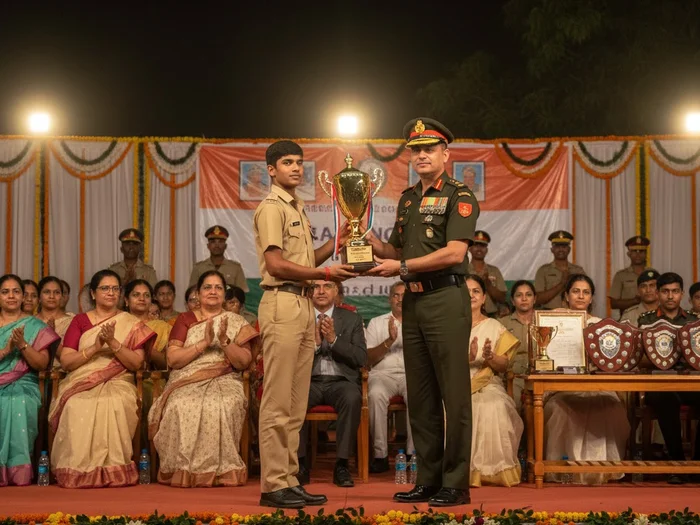

Most parents focus hard on getting their child into a Sainik School. And that's the right instinct. But here's a question many families don't ask early enough — what actually happens after those six years? Where does a Sainik School student end up? Is the Army the only road, or are there other paths? And how many students really make it to NDA?
These are fair questions. And the answers are more interesting than most people expect. Sainik School is not just a stepping stone to a defence career. It shapes a child in ways that open multiple doors — in the armed forces, in top engineering and medical colleges, in civil services, and even in the private sector. Let's walk through what life looks like after Sainik School, one stage at a time.
First, What Does Sainik School Actually Do to a Child?
Before we talk about career paths, it helps to understand what six years inside a Sainik School actually produces. These are residential schools. Students live away from home, follow a strict daily routine, and balance academics with physical training, leadership activities, and NCC. It's not an easy life. But it builds something most schools can't — mental toughness.
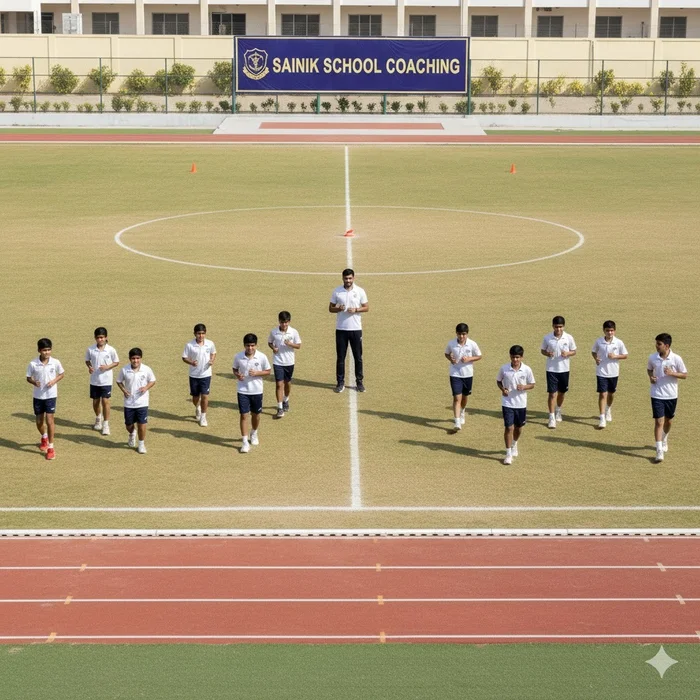
A Sainik School student wakes up early, manages their own time, handles pressure, and learns to work in a team from a young age. By the time they reach Class 12, they carry a level of discipline and confidence that sets them apart in any competitive process — whether that's an NDA written exam, a JEE paper, or a civil services interview.
So whatever career path they choose, the foundation is already strong. That's the real value of Sainik School — not just the defence gateway, but the person it builds.
The NDA Route — The Most Common Path
The National Defence Academy ↗ entrance exam is where most Sainik School students aim. NDA is held twice a year by UPSC ↗. It's open to Class 12 pass students between 16.5 and 19.5 years of age. After clearing the written exam, candidates go through an SSB interview — a five-day selection process that tests intelligence, personality, and leadership potential.
Sainik School students have a natural edge here. The SSB tests exactly what Sainik School builds — confidence under pressure, group communication, physical fitness, and quick thinking. This is not an accident. Sainik Schools were set up by the Ministry of Defence with NDA in mind. The entire curriculum and lifestyle of these schools is designed to prepare students for this exact process.
So what does the NDA success rate look like for Sainik School alumni? While exact numbers vary by school and year, data consistently shows that Sainik School students clear NDA at a rate significantly higher than the national average. Some schools report that 30 to 50 percent of their eligible students qualify for NDA each year. The national selection rate across all candidates is far lower — often in single digits. The difference is visible and consistent.
Once through NDA, a student spends three years at the academy in Pune — earning a degree and commissioning as an officer in the Indian Army, Navy, or Air Force. It's a career that starts with rank, respect, and a lifetime of structured growth.
Not Just the Army — Other Defence Careers After Sainik School
NDA is the biggest gateway, but it's not the only one. Students who don't clear NDA, or who choose a different route, still have strong defence options available.
The Technical Entry Scheme, or TES, allows Class 12 students with a strong Maths and Physics background to join the Army as officers through a separate technical route. No written exam is required — selection happens through SSB and merit in Class 12. Many Sainik School students take this path successfully.
The Indian Military Academy in Dehradun, the Officers Training Academy in Chennai, and the Naval Academy in Ezhimala all have entry routes open to graduates. Students who complete their graduation first and then join defence services through CDS — the Combined Defence Services exam — also represent a significant portion of Sainik School alumni.

The Air Force has its own AFCAT exam. The Navy has its own direct entry schemes. Sainik School students, having spent years in a defence-oriented environment, are well prepared for any of these selection processes. The discipline, fitness, and awareness they carry gives them a head start in every interview and selection round.
What If a Student Doesn't Want a Defence Career?
This is a question many parents hesitate to ask, but it's completely valid. Not every child who goes to Sainik School will want to join the armed forces. And that's okay. Sainik School is not a forced pipeline into defence. It's a quality education with a strong value system.
Many Sainik School alumni go on to crack IIT JEE and enter premier engineering colleges. Some pursue medicine. Some go into management and appear for CAT. Others join the civil services through UPSC and become IAS or IPS officers. The discipline and work ethic that Sainik School instils makes students competitive in any field they enter.
In fact, several Sainik School alumni have gone on to build careers in business, law, journalism, and even the arts. The school doesn't limit a child's future — it strengthens the foundation so the child can build anything on top of it.
What parents often find is that children who come out of Sainik School are simply more sorted. They know how to manage time. They handle failure without falling apart. They communicate clearly. These traits serve a person well in every profession — not just in the armed forces.
The NDA Success Rate — What the Numbers Tell Us
Let's talk about this more directly. Every year, roughly four to five lakh students appear for the NDA written exam. UPSC selects around 400 candidates per exam — which means about 800 per year across both NDA 1 and NDA 2. That's a selection rate of well under one percent from the general pool.
Sainik School students operate in a very different bracket. Multiple Sainik Schools across India regularly report that a large share of their Class 12 graduates either join NDA directly or qualify through later attempts. Schools like Sainik School Rewari, Sainik School Rewa, and Sainik School Kazhakootam have long track records of high NDA selections.
The reason isn't magic. It's years of consistent preparation — physical fitness maintained from Class 6, regular NCC training, mock SSB sessions in senior years, academic pressure that matches competitive exam standards, and a peer group that takes the NDA goal seriously. When every student around you is working toward the same thing, the standard rises for everyone.
For a parent wondering whether Sainik School is worth the effort of the entrance process — the answer is in these numbers. The investment at Class 6 pays off clearly by Class 12 and beyond.
Life After NDA — What an Officer's Career Looks Like
For students who do make it through NDA and commission as officers, the career that follows is genuinely remarkable. Officers in the Indian Armed Forces enjoy a lifestyle that combines purpose, prestige, and stability in a way few careers can match.
The pay structure has improved significantly over the years, especially after the 7th Pay Commission. Officers receive competitive salaries, free housing, medical benefits for the entire family, education allowances for children, and access to well-maintained residential colonies and clubs. The non-monetary benefits — respect, camaraderie, a sense of mission — are things that are hard to put a number on but very real to the people who live them.
Career growth in the armed forces is structured and transparent. Officers rise through ranks based on merit and seniority. Many go on to command units, lead regiments, and eventually reach senior positions like Brigadier, Major General, or higher. Some transition into strategic roles, teach at defence institutions, or take on UN peacekeeping assignments abroad.
After retirement — which can come as early as the late forties — ex-servicemen have strong placement opportunities in the private sector, PSUs, and government departments through the Ex-Servicemen re-employment schemes. Many go on to second careers that are equally fulfilling.
So Is Sainik School Worth It?
Step back and look at the full picture. A child who clears the Sainik School entrance at Class 6 spends six years in one of India's most structured and well-supported residential school systems. They come out disciplined, physically fit, academically prepared, and mentally tough. They carry an edge in NDA, CDS, JEE, UPSC, and in life generally.
Even if they don't join the armed forces — even if they choose engineering, civil services, or business — the six years they spent in Sainik School gave them something most of their peers simply don't have. And for the ones who do go the NDA route, a career awaits that is genuinely one of the most respected in the country.
The seat at Sainik School is hard to get. The entrance exam is competitive. But the return on that effort — measured across a full life — is difficult to beat. If your child has the interest and you have the will to support the preparation, this is one of the best investments a family can make.