This is something many parents do not realise.
Every year, students clear the written exam for Sainik School, RMS and RIMC ↗. Some even score very good marks.
But later, their name is missing from the final list.
The reason is not always knowledge.
Many students know the answers. They just cannot say them properly.
The panel understands what the child is trying to say. But the answer comes out unclear. Broken sentences. Very short replies. Low voice.
And that is enough for the panel to choose someone else.
Communication is not about speaking perfect English. It is about speaking clearly. It is about expressing your thoughts in a way the other person understands.
Most students never practise this.
They prepare only for the written exam.
What Weak Communication Looks Like in the Interview
Here are common things that happen inside the interview room.
One-word answers
Panel asks, “What do you do after school?” Student says, “Play.”
Nothing more. The panel waits. The student stays silent.
Incomplete sentences
The student starts speaking. Then gets confused. Stops in the middle.
This usually happens because of nervousness and lack of practice.
Mixing languages
The student switches between Hindi and English again and again. In daily life this is normal. In an interview, it makes the answer difficult to follow.
No structure
The student jumps from one point to another. Repeats the same thing. Goes off topic.
After two minutes, the answer still feels incomplete.
Very low voice
Many students speak so softly that the panel asks them to repeat.

Once is fine. Again and again gives a poor impression of confidence.
The important thing is this — These are not talent problems.
They are practice problems.
Why Most Students Struggle to Speak
There is no mystery here.
Schools focus on writing, not speaking
Students write exams. They learn answers. But nobody asks them to explain things out loud.
A child may score high marks and still struggle to speak for two minutes.
English is treated like a subject
Students learn grammar rules. They memorise essays.
But they rarely use English in real conversation.
So when the panel speaks to them, they freeze.
No speaking habit at home
At home, conversations are usually short. Homework. Marks. Tests.
Children rarely get a chance to explain their thoughts or opinions.
Too much screen time
Phones and videos mean less talking.
Children watch. They listen. But they do not express.
Over time, confidence in speaking goes down.
Fear of making mistakes
Many children are scared to speak because they think they will say something wrong.
This fear becomes very visible in the interview.
What the Interview Panel Actually Wants
The panel is not expecting a perfect speaker.
They know these are young students.
They look for simple things.
- Answer in full sentences
- Stay on the topic
- Speak clearly and loudly
- Think and respond, not memorise
- Use basic manners like “Sir” or “Ma’am”
- Say “I don’t know” if unsure
That’s it.
The level is not very high.
But without practice, many students still struggle.
Simple Ways to Improve Communication at Home
These steps are easy. They just need consistency.
Ask your child to describe their day
Every evening, ask them to explain what happened during the day. Step by step.
This builds thinking and speaking together.
Give a topic and ask them to speak for 2–3 minutes
Topics like:
- My favourite game
- My school
- What I want to become
Do this three times a week.
You will see improvement within a month.
Correct gently
Do not laugh or scold.
If a sentence is wrong, repeat it correctly and move on.
Confidence grows only in a safe environment.
Encourage real conversations
Let the child talk to relatives. Let them answer the phone sometimes.
Small interactions help a lot.
Reduce screen time
Replace one hour of screen time with family conversation.
It makes a big difference.
Reading aloud
Ask the child to read for 10–15 minutes daily.
This improves pronunciation, speed and confidence.
Record and play back
Ask a question. Record the answer.
When children hear themselves, they notice mistakes and improve faster.
The Gap in Most Coaching Centres
Most coaching centres focus only on the written exam.
Few work on communication.
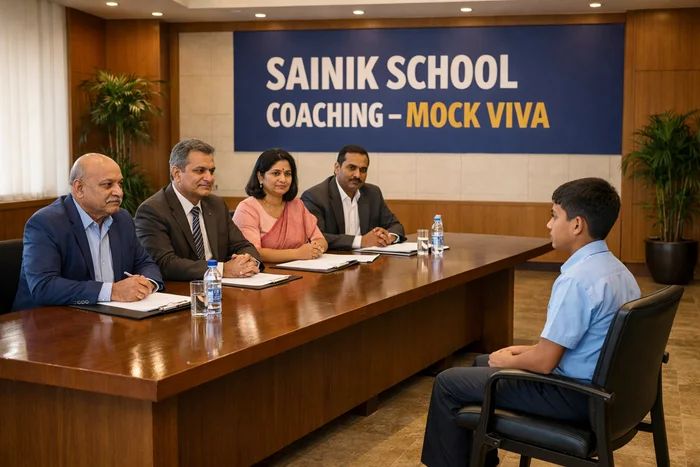
Few conduct proper mock interviews.
But the interview stage is equally important.
If a student clears the exam but cannot speak confidently, the result is the same.
No selection.
How Good Coaching Helps
A proper programme should include:
- Regular speaking practice
- Mock viva sessions with a panel
- Feedback after every interview
- Group discussions
- Reading and explanation practice
- Written exam preparation along with communication
When students practise interviews multiple times, their fear reduces.
By the real interview day, the situation feels familiar.
Small Tips for Interview Day
-
Greet clearly when you enter
- Sit straight
- Take a second before answering
- Speak in sentences
- Maintain eye contact
- If you don’t know, say politely
- Say thank you before leaving
These small things create a strong impression.
Final Thought
Your child may study for months.
All that hard work should not be lost because of weak communication.
The interview does not require a perfect speaker.
It only requires a child who can speak clearly and confidently.
And this skill can be developed.
With regular practice.
With the right guidance.
If preparation covers written exam, medical and interview together, the chances of selection increase a lot.
That is how complete preparation should be done.