When a child clears the written exam and the interview, there is still one more gate to pass — the medical round. This is where many families get a shock they never saw coming. Their child studied hard, scored well, and made it through the selection process — only to be rejected on medical grounds. One of the most common reasons is BMI. Understanding what BMI means, how it is calculated, and what range is acceptable for Sainik School admission ↗ can save your child from that last-minute heartbreak.
What Is BMI and Why Does It Matter for Sainik Schools?
BMI stands for Body Mass Index. It is a number calculated from a person's height and weight. The formula is simple — weight in kilograms divided by height in metres squared. For children, BMI is not read as a fixed number. It is read as a percentile against other children of the same age and gender. A child who falls below the healthy range is considered underweight. A child above the range is considered overweight. Both can lead to medical rejection at the time of Sainik School admission.
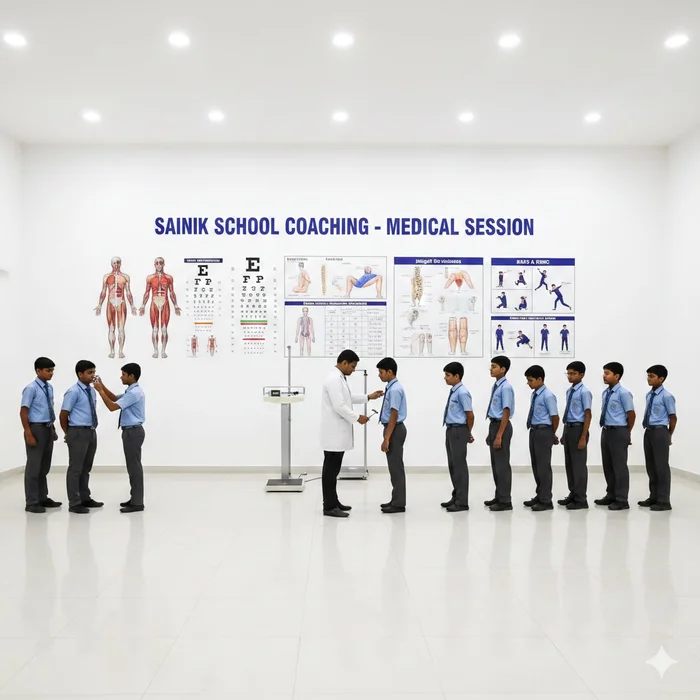
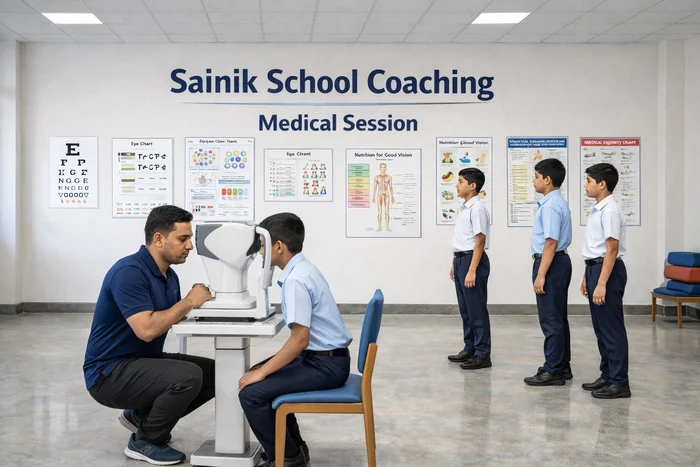
Sainik Schools follow the medical standards set by the Ministry of Defence. The medical examination is conducted after the written test and interview. It checks vision, hearing, dental health, physical proportions, and weight-for-height ratio. There is no separate published BMI cut-off chart released by NTA or the Sainik Schools Society. However, the medical board uses standard Indian paediatric growth references and armed forces medical guidelines to assess whether a candidate's weight is proportionate to their height and age.

General BMI Reference for Children Aged 10 to 16
The following ranges are based on standard WHO and Indian Academy of Paediatrics guidelines used as reference points in medical assessments:
| Age | Healthy BMI Range (Approximate) |
|---|---|
| 10 years | 14.5 — 19.0 |
| 11 years | 15.0 — 19.9 |
| 12 years | 15.5 — 21.0 |
| 13 years | 16.0 — 21.9 |
| 14 years | 16.5 — 23.0 |
| 15 years | 17.0 — 23.5 |
| 16 years | 17.5 — 24.0 |
These are approximate healthy ranges. The medical board does not use BMI alone. Height-weight proportion, chest measurement, and overall physical fitness are all assessed together.
What Happens If BMI Is Outside the Range?
A child who is mildly underweight or overweight is not automatically rejected. The medical board looks at the overall picture. However, a significant deviation — being severely underweight or obese — will result in the candidate being declared temporarily unfit or permanently unfit depending on the degree. Parents should not wait for the medical date to check this. A simple visit to a paediatrician six to eight months before the exam gives enough time to correct weight through diet and supervised physical activity.
What You Should Do Right Now
Get your child's height and weight measured today. Calculate the BMI. If it falls outside the healthy range for their age, speak to a doctor and start working on it — not two weeks before the medical, but now. A child who is physically fit walks into the medical round with confidence. That confidence carries over into the interview and the written exam too. Fitness is not just a medical requirement. It is a mindset that Sainik Schools look for from day one.